Overview
Integrated Cardiocerebrovascular Services National Hospital Dr. Cipto Mangunkusumo was inaugurated on September 17 2003 and is a pioneer of integrated heart services at public hospitals in Indonesia. Integrated Cardiocerebrovascular Services carries the principle of integrated and multidisciplinary cardiovascular treatment by involving several main and supporting Medical Staff Groups (KSM), namely:
KSM Internal Medicine, Cardiovascular Division
KSM Pediatric Health Sciences, Cardiology Division
KSM Surgery Division of Cardiac and Vascular Thoracic Surgery
KSM Anesthesiology and Intensive Therapy.
KSM Physical Medicine and Rehabilitation
KSM Nutrition Clinic
The RSCM Integrated Cardiocerebrovascular Services provides comprehensive cardiovascular services ranging from consultations, non-invasive and invasive diagnostics, heart surgery and invasive non-surgical correction measures, medical rehabilitation to clinical nutrition management.
In 2018, a Heart Failure Team was formed and in 2019 a Heart Failure Polyclinic Service was opened to provide integrated and comprehensive services to heart failure patients at the Dr. Cipto Mangunkusumo National General Hospital and Indonesia in general. The team consists of various scientific disciplines and coordinates with each other in an integrated heart failure service program.
As part of the referral center hospital, Integrated Cardiocerebrovascular Services RSCM continues to develop cardiovascular services following developments in science and technology. The latest non-invasive diagnostic examinations such as 4D echocardiography, intensive care using adequate equipment, and superior services are a form of IPJT RSCM's concern in efforts to treat cardiovascular disease in Indonesia, starting from screening to surgical and non-surgical management in accordance with the guidelines provided. There is.
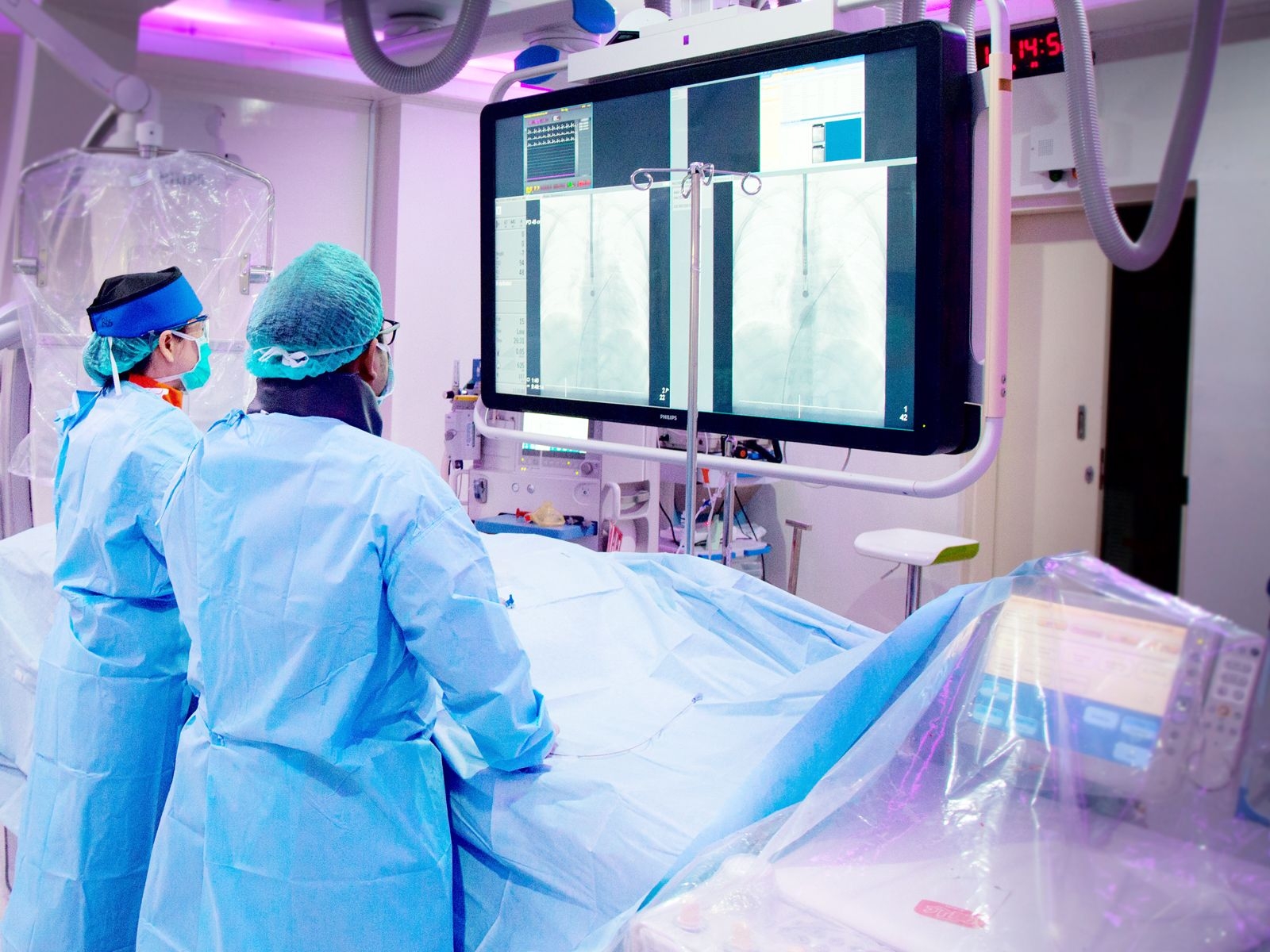
One of Integrated Cardiocerebrovascular Services RSCM's superior services is ablation to treat heart rhythm disorders and installation of a Permanent Pacemaker with physiological pacing. Some types of electrical heart rhythm disorders can be treated with invasive measures without surgery, known as Electrophysiology Study (heart electrical study) and ablation through a special catheter. Integrated Cardiocerebrovascular Services RSCM already uses three-dimensional (3D) electrical mapping, with the advantage of reducing patient exposure to radiation and contrast agents. The accuracy and success rate are higher compared to previous conventional tools.
So far Integrated Cardiocerebrovascular Services RSCM has provided Electrophysiology Study services Ablated more than 400 patients with a success rate of 97.4%. Cases treated include Atrial Fibrillation, Ventricular Tachycardia, Premature Ventricular Complex, Wolff-Parkinson-White Syndrome, other Supraventricular Tachycardia and patients with decreased heart pump function. In addition, zero fluoroscopy ablation has been performed on pregnant women with satisfactory results. Integrated Cardiocerebrovascular Services RSCM also provides pacemaker implantation services for patient needs, such as Permanent Pacemaker (PPM), Implantable Cardiac Defibrillator (ICD) and Cardiac Resynchronization Therapy (CRT).
Carrying out its mandate as a teaching hospital, in 2018 Integrated Cardiocerebrovascular Services RSCM received recognition as one of the CRT Implant training centers in the Asia Pacific area and since 2019 Integrated Cardiocerebrovascular Services RSCM has also been included as a heart service in Southeast Asia which is capable of implanting more physiological permanent pacemakers, known as His Bundle Pacing/Left Bundle Pacing . During the 2019-2023 period, 300 actions have been carried out at Integrated Cardiocerebrovascular Services RSCM with a success rate of 100%.
In the field of surgery, Integrated Cardiocerebrovascular Services RSCM has developed surgical procedures that will provide more comfort to patients, namely minimally invasive surgical services ( Minimum Invasive In Cardiac Surgery), CABG off pump and also accommodate surgery in complex congenital heart cases ( Complex Congenital Heart). Surgery). Every year Integrated Cardiocerebrovascular Services RSCM performs around 400 pediatric heart surgery patients and around 200 adult heart surgery patients.
Integrated Cardiocerebrovascular RSCM Featured Services:
Cardiac Resynchronization Therapy (CRT) or cardiac resynchronization therapy is a treatment carried out on patients who experience heart failure due to unsynchronized heartbeats between the right ventricle of the left ventricle and the right atrium of the left atrium. . Synchronization of the movements of the two chambers (ventricles) and two atria (atria) of the heart.
Thoracic Endovascular Aortic Repair (TEVAR) is a treatment method by inserting a special catheter into a blood vessel for patients who have a thoracic aortic aneurysm, while Endovascular Aneurysm Repair (EVAR) is a treatment method by inserting a catheter into a blood vessel for patients who have an abdominal aortic aneurysm.
Electrophysiology (EP) Study is a test of the heart's electrical activity and to diagnose forms of arrhythmia or abnormal heart rhythms. Cardiac arrhythmia is a condition where the heart's muscles do not coordinate harmoniously, causing the heartbeat to become irregular, faster or slower. Heart arrhythmias can be felt by sufferers as a feeling of palpitations or a fast or slow heartbeat, chest pain or difficulty breathing, fatigue quickly, and they can even faint suddenly. In treating cardiac arrhythmias, a radiofrequency ablation procedure is carried out for treatment. EP study and ablation can be performed together in the catheterization room. When an arrhythmia is identified during an EP study , the doctor can immediately perform radiofrequency ablation in the area where the abnormal heart electricity is found.
Child intervention measures (ASD, VSD, PDA, PFO)
Transcatheter closure of ASD is the closure of a hole in the heart in the atrial wall without surgery using a closing device or occluder .
Transcatheter closure of PDA is the closure of a hole in the heart in the wall of the aorta and pulmonary artery using a closing device or occluder .
Transcatheter closure of VSD is the closure of the hole in the heart between the chambers using a closing device or occluder .
Transcatehter closure of PFO is the closure of the hole in the heart between the right and left upper chambers of the heart using a closure or occlude device.
Heart failure clinic: special service for patients suffering from heart failure. Heart failure is a condition where the heart cannot pump blood throughout the body as it should. Services are provided by providing pharmacological therapy (drugs that must be consumed) and non-pharmacological (diet, drinking water, and cardiac rehabilitation programs).
His bundle pacing : A new strategy for physiological ventricular activity, in the form of installing a pacemaker at the His bundle location.
Minimally Invasive Cardiac Surgery (MICS) is a heart surgery technique with smaller surgical wounds/incisions/incisions compared to ordinary heart surgery techniques which generally require large surgical wounds or require a sternotomy (sternum cleavage technique).
Complex Congenital Heart Surgery is surgery for cases of congenital heart disease that are complex and generally difficult to handle in hospitals with limited health facilities and health personnel. The surgery for complex congenital heart disease cases in question is the Rastelli Procedure , Fontan Procedure , or surgery to repair the large blood vessels of the heart whose positions have been confused.
New Services at Integrated Cardiocerebrovascular Services RSCM
The development of medical science has found that blood clots in the heart chambers and heart rhythm disturbances can cause an increase in the incidence of stroke, especially for patients at high risk of stroke or recurrent stroke patients. Currently at Integrated Cardiocerebrovascular Services RSCM a Left Atrial Appendage (LAA) occluder procedure has been carried out . The LAA Occluder procedure is the action of closing the left atrial appendage (a complementary space in the left atrium (left heart atrium) using a special tool. This action is carried out in the cardiac catheterization room without using surgery (transcatheter). The aim of closing the LAA is to reduce the risk of clots releasing the blood in the left atrium of the heart enters the body's circulatory system, especially the brain, which can trigger strokes or recurrent strokes in patients who have had a stroke.
